
AI Skills Boost: the UK government is solving access – support is the bigger problem
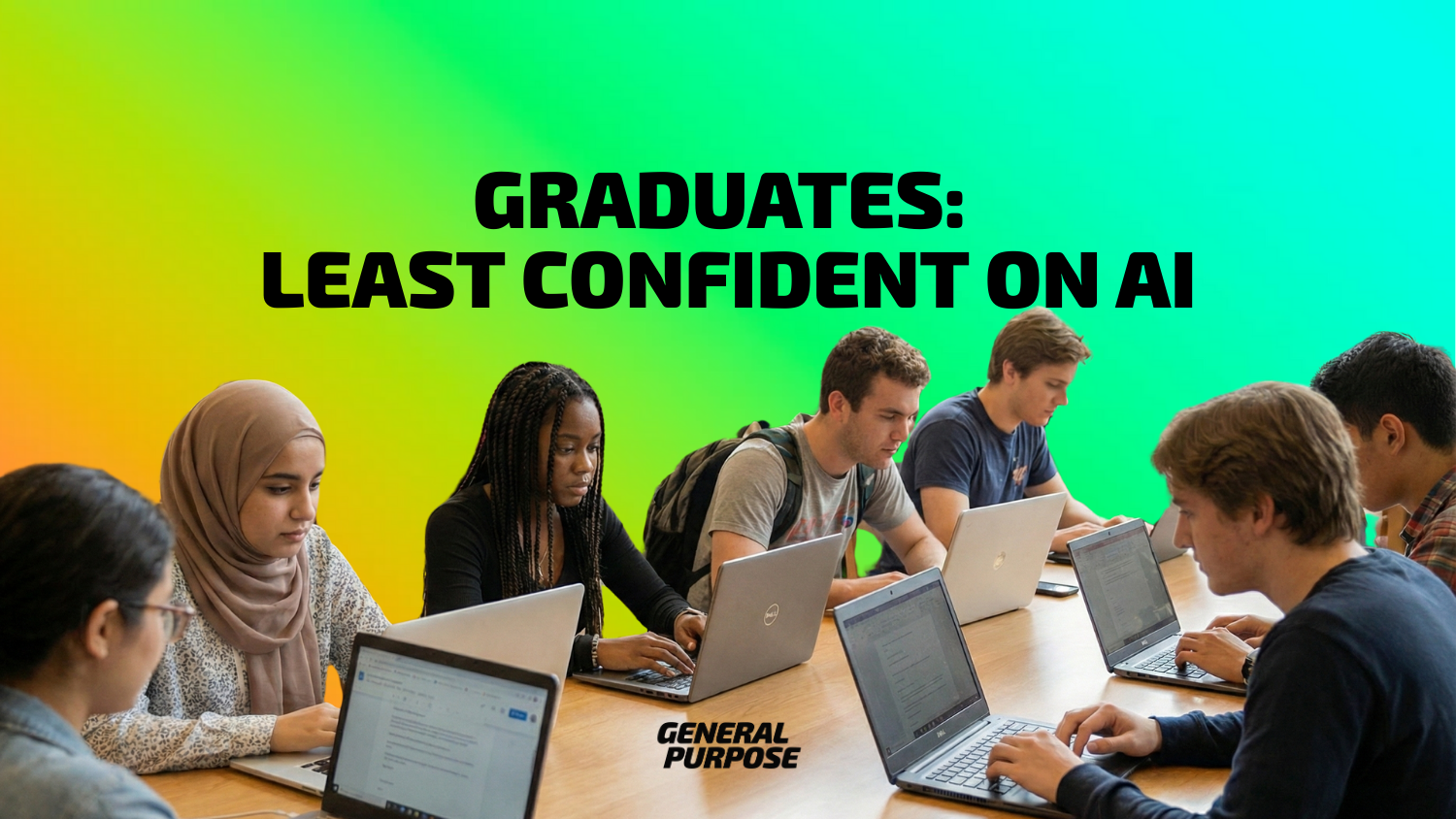
LinkedIn's Workforce Confidence Index shows 18–28-year olds are the least confident generation about AI upskilling – only 40% feel confident they'll learn AI skills in the next six months.
Last updated on Thursday 29 January 2026———————
Yesterday, the government launched an update to their ambitious AI skills programme. Free AI training for every adult in the UK. Fourteen courses. Eight providers. A target of 10 million workers upskilled by 2030.
It's good news. But we don't think it's enough.
Not because the programme is bad – it isn't – but because access isn't the problem. Support is. And that's something we're trying to address at General Purpose.
What is the AI Skills Boost programme?
AI Skills Boost is a free online training offer from the government, built with partners including Google, Microsoft, IBM, Accenture, and Salesforce. Courses range from 20 minutes to a full day, covering foundational AI skills like prompt writing, understanding risks, and interpreting data. Complete one and you get a digital badge.
You can access them now using the links in the FAQs.
What is General Purpose doing to help those who fall through the cracks?
A few times a year, we open our corporate training to individuals through what we call Open Enrolment. It started as a way to look after our existing clients – but as part of our commitment to becoming a B Corp, we've decided to make Open Enrolment free for students and recent graduates – those who are currently most impacted by the rise of AI and the drop in entry-level roles.
If you're 18 or over, and you're either currently in full-time education or graduated within the past 18 months, you can join our next ChatGPT Essentials workshop at no cost. Same training, same instructors, same exercises as the people whose employers paid £349.
Read on to find out how you can get access.
What does the AI Skills Boost programme do well?
Three things.
It reduces barriers. Anyone with internet access can get AI training from credible providers without paying a penny.
It raises the baseline. If millions of people understand what AI can and can't do, that's millions of better informed citizens who can approach AI with understanding rather than fear. A more informed workforce can make better decisions about how to use AI in their lives and work.
And it forces the conversation. When the government puts this much weight behind AI skills, it gives those companies a reason to prioritise it. As we’ve written about previously, if you’re not ‘officially’ using AI in your business, you can bet that some of your employees are using it unofficially – and likely in a way that isn’t AI EU Act-compliant.
So what's the problem with the AI Skills Boost programme?
The problem is that free courses have existed for years. The content was already there.
And yet, according to the government's own data, only 21% of UK workers feel confident using AI at work. Only one in six businesses are using it.
If training solved the awareness problem, we'd already be there. And that’s before we’ve even examined the impact of AI on graduates.
We see it in General Purpose classes – and the data proves it: graduates are the least confident about AI
Published yesterday, LinkedIn’s Workforce Confidence Index shows a generational divide that might surprise you: Gen Z – the so-called digital natives – are the least confident about AI upskilling.
Only 40% of 18-28 year olds feel confident they'll proactively learn AI skills in the next six months. Compare that to 63% of millennials and 61% of Gen X.
Why? Helen Tupper, co-founder of Squiggly Careers, puts it simply: "Experience plus AI equals action."
This is something we see in classes around the world, from training private equity firms, to sustainable business companies, household name FMCG brands to universities: older workers and senior managers are more likely to be adopting AI at pace.
Without years of work experience, it's harder to see where AI can make the biggest difference at work. You don't know what problems need solving. You don't have workflows to improve. You're learning a tool without context for how to use it.
And that's a problem, because graduates are also the people whose job prospects seem to be most threatened by AI. The tasks that used to train junior employees – research, drafting, summarising, scheduling – are exactly the tasks that generative AI currently handles best. Companies are hiring fewer entry-level staff and expecting mid-level employees to use AI instead.
So graduates face a double bind: they need AI skills more than anyone, but they're the least equipped to learn them from self-directed online courses.
More broadly, UK workers don’t feel supported to learn AI
On the same day as the government’s announcement, LinkedIn’s Workforce Confidence Index showed some more striking insights in AI rollout in the workplace:
57% of UK workers say they'll learn AI skills in the next six months. But only 39% feel they have the support to do it.
That's an 18-point gap between wanting to learn and feeling supported to learn.
Which means that the issue isn't access. It's support.
What type of AI training builds confidence and gives workers and graduates the support they need?
If you've ever completed an online course and still felt stuck when it came to actually doing the thing, you already know the answer.
The gap between "I watched a video" and "I confidently use this at work" isn't closed by more videos. It's closed by context – practice, feedback and interaction that can help you see how your new AI knowledge can be directly applied to your role.
That means human instructors who can answer your questions in real-time. Cohort-based learning, where you see that everyone's at a different level – and that's fine. Where you can share what's working and steal ideas from people in different industries.
It means training that's tied to real business problems, not generic examples.
And it means being tool-agnostic – helping you use whatever AI tool makes sense for your situation, rather than training you on the product the training provider happens to sell.
About “Open Enrolment”: General Purpose's live training for freelancers, consultant, small teams and students
We’ve trained employees from all around the world, at companies like BT, Hilton, Lloyd's of London, OpenAI, and Virgin Media O2. Half-day or full-day workshops, live instructors, hands-on exercises with real business problems. Our attendees save an average of 47 minutes a day afterwards. 79% go on to use AI daily at work.
A few times a year, we open these sessions to individuals through what we call Open Enrolment. It started as a way to look after our existing clients – new joiners can get up to speed in the next Open Enrolment session rather than waiting months until there are enough of them to warrant a dedicated workshop. It's also how freelancers and consultants access the same training we deliver to corporate clients.
How to get a free place on our Open Enrolment AI training
Our next session is Monday 30 March 2026, 2pm–5:30pm, online.
Book your ticket on Luma. If you're eligible for a free place, get in touch with proof of your student status or graduation date (student ID, enrolment letter, or LinkedIn profile showing when you graduated) and we'll send you a code.
Places are limited and paying attendees get priority. But we'll fit in as many graduates as we can.
The government's programme is a good start. But if the goal is to make sure no one gets left behind, there's room for more than one approach.
We'd welcome the conversation.
Susi Castle is Chief Marketing Officer at General Purpose, the UK's leading AI training company. They've delivered hands-on AI training to thousands of people at organisations including BT, Three, Hilton, Network Rail, Virgin Media O2, and Kimberly-Clark.
FAQs
What is the difference between AI Skills Boost and hands-on AI training? The AI Skills Boost provides free, self-directed online courses covering foundational AI concepts. Hands-on training like General Purpose's workshops includes live instruction, real-time Q&A, cohort-based learning with peers, and exercises tied to actual business problems. The government programme builds awareness; structured training builds confidence through practice and support.
Why do only 39% of workers feel supported to learn AI skills? According to LinkedIn's Workforce Confidence Index, there's an 18-point gap between workers who want to learn AI skills (57%) and those who feel supported to do so (39%). This suggests that access to training content isn't the main barrier – the gap is in guided practice, feedback, and workplace support for applying new skills.
Why are Gen Z workers least confident about AI upskilling? LinkedIn data shows only 40% of Gen Z workers (aged 18-28) feel confident they'll proactively learn AI skills in the next six months, compared to 63% of millennials and 61% of Gen X. Career expert Helen Tupper suggests this is because "experience plus AI equals action" – without workplace experience, it's harder to see where AI tools add value, making self-directed learning less effective.
Is there free AI training for graduates in the UK? Yes. The government's AI Skills Boost offers free foundational courses to all UK adults. General Purpose provides free access to their half-day ChatGPT Essentials workshop for anyone aged 18+ who is currently in full-time education or graduated within the past 18 months.
What support do graduates need to learn AI effectively? Graduates face a particular challenge: they need AI skills to compete in a changing job market, but lack the workplace context that makes self-directed learning effective. Effective support includes live instruction with real-time Q&A, cohort-based learning to share approaches with peers, exercises tied to realistic business problems, and tool-agnostic guidance rather than vendor-specific training.
What government AI courses are available for adults?
The AI Skills Boost programme offers 14 courses from eight providers, all benchmarked against Skills England's "AI Foundation Skills for Work" framework. Topics include creating prompts, adapting AI settings, using dashboards to interpret data, and understanding the risks of AI use. The courses are self-directed and online, with a digital badge on completion. They're designed for all adults but have a particular focus on small and medium-sized businesses where AI adoption has been slower.
Can graduates get free ChatGPT training?
Yes. The government's AI Skills Boost offers free foundational AI courses to all UK adults, including graduates. For more hands-on training, some providers offer free places specifically for students and recent graduates. General Purpose provides free access to their half-day ChatGPT Essentials workshop – the same session that normally costs £299–£349 – for anyone aged 18+ who is currently in full-time education or graduated within the past 18 months. Email hi@generalpurpose.com with proof of student status or graduation date to request a code.
What's the best AI training for beginners in the UK?
It depends on what you need. For foundational awareness – understanding what AI can do, basic prompt writing, recognising risks – the government's free AI Skills Boost courses are a solid starting point. For practical confidence – learning to use AI tools effectively for real work tasks – live workshops with instructors, exercises, and Q&A tend to be more effective. General Purpose's ChatGPT Essentials is a half-day workshop covering prompt writing, solving business problems with AI, and using AI safely. It's tool-agnostic in approach, though the exercises use ChatGPT. Their bespoke in-house training covers whichever tool a team actually uses: Claude, Copilot, Gemini, or ChatGPT.
