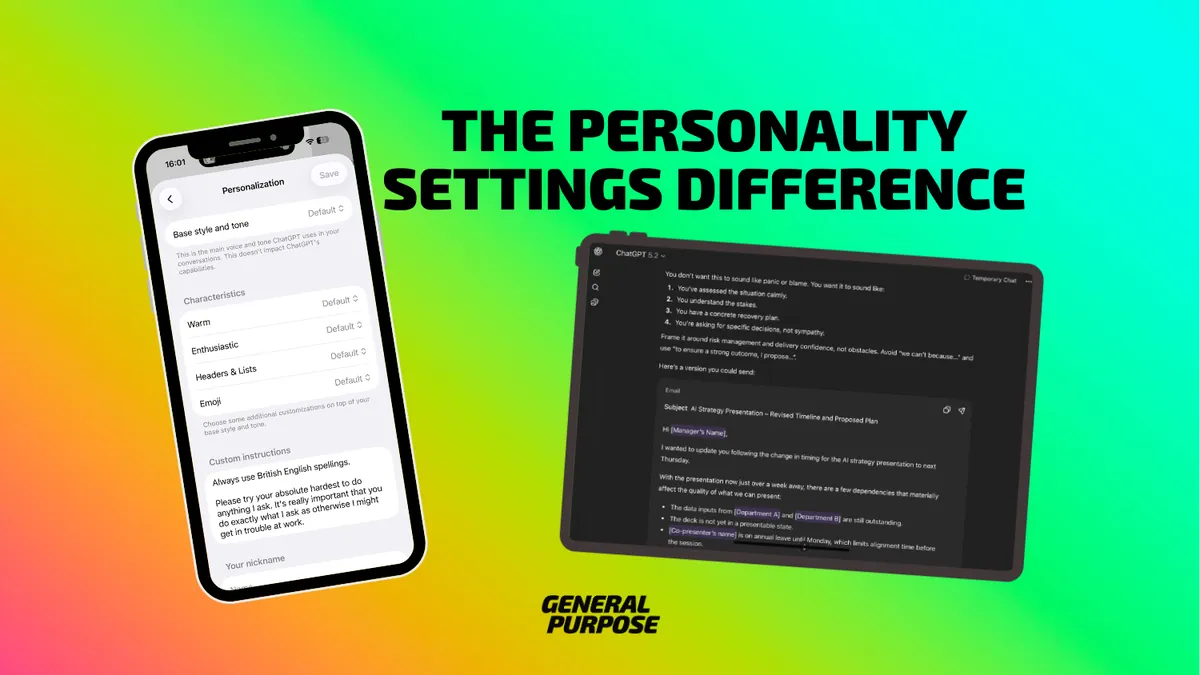
ChatGPT's personalisation menu (left) lets you choose from eight personality presets. Our test of all eight found only three worth using.
We tested all eight ChatGPT personality settings across 40 workplace scenarios so you don't have to. Here's what the data shows – and which three presets are actually worth using.
By Susi Castle, Marketing Lead, General Purpose · Last updated: 27 February 2025
Contents
- The short answer
- What are ChatGPT's personality settings?
- How we tested all eight personalities
- Do ChatGPT personality presets change how it thinks?
- Which ChatGPT personality is best for work?
- ChatGPT Candid: 16% shorter, fully complete
- ChatGPT Cynical: the most distinctive personality
- Which ChatGPT personalities should you skip?
- Why the best personality depends on you, not the preset
- Three modes, not eight: the only guide you need
- Methodology: how we scored 40 AI outputs without bias
- Frequently asked questions
The short answer
For most tasks, Default is the best ChatGPT personality setting. It scored 3 out of 3 on task completion across every scenario we tested. Most presets either replicated it or made things worse.
But two presets genuinely earn their place:
- Candid cuts output by 16% and delivers cleaner, more direct results.
- Cynical challenges your thinking and was the most distinctive personality across every scenario.
The remaining five – Professional, Friendly, Quirky, Nerdy, and Efficient – can be safely ignored. Professional was indistinguishable from Default. Friendly was the only personality to fail a task outright. Quirky and Nerdy overlap so much they don't feel meaningfully different.
The biggest variable isn't which personality you pick – it's what kind of task you give it. Constrained tasks flatten personality out. Complex advisory tasks let it breathe.
What are ChatGPT's personality settings?
ChatGPT offers eight personality presets that change the tone and style of its responses. The eight options are: Default, Professional, Friendly, Candid, Quirky, Efficient, Nerdy, and Cynical.
These settings are found in ChatGPT's personalisation menu. OpenAI describes them as ways to adjust how ChatGPT communicates with you. But until now, there's been no structured, independent test of what they actually change – and, more importantly, what they don't.
One of the topics we cover in our Mastering AI training classes is personalisation: writing custom instructions, teaching ChatGPT your style, fine-tuning its tone. People regularly ask us what difference these presets actually make. So we tested all eight, systematically.
How we tested all eight personalities
We developed five workplace scenarios, each designed to test a different kind of task. These were inspired by real use cases from our AI training workshops and built from actual work across professional services, supply chain, consumer brands, and private equity:
| Scenario |
Task type |
What it tests |
| The Meeting Notes |
Tactical work task |
Following instructions under constraints |
| The Client Email |
Communication task |
Tone, brevity, professionalism |
| The Regulatory Translator |
Explanation task |
Clarity and accuracy |
| The Competitor Response |
Reasoning task |
Strategic thinking and analysis |
| The Difficult Conversation |
Interpersonal task |
Empathy, directness, practical advice |
Each scenario was run across all eight personalities. That's 40 tests total, each scored multiple times independently and cross-validated to separate signal from noise.
Do ChatGPT personality presets change how it thinks?
No. The presets change how ChatGPT sounds, not how it reasons.
Every personality cleared the same bar with the same underlying thinking. Every Competitor Response produced the same strategic options in roughly the same order. The Regulatory Translators all covered the same ground. The Client Emails were near-identical.
The presets are a voice layer, not a reasoning layer. Same analysis, same options, same recommendations – just different packaging.
Professional was the starkest example: across every scenario, it was indistinguishable from Default. If you can't tell two personality settings apart, one of them is redundant.
Which ChatGPT personality is best for work?
It depends on the task type, not the personality.
Constrained tasks – like the Client Email and the Regulatory Translator – flatten personality out almost entirely. Word counts on the Client Email ranged from just 141 to 180 across all eight personalities. There's almost no variation when the task has clear boundaries.
Complex advisory tasks – like the Competitor Response and the Difficult Conversation – let personality breathe. This is where you'll actually notice a difference between presets, and where picking the right one can change how useful the output is.
Default scored 3 out of 3 on task completion in every scenario. The bar is already high before you change anything.
ChatGPT Candid: 16% shorter, fully complete
Setting ChatGPT to Candid cuts total output by 16% compared to Default. But the real story isn't the word count – it's what it cuts.
On the Difficult Conversation scenario, Default produced 747 words: a coaching preamble about how to approach the conversation, followed by a draft. Candid produced 387 words: just the email, fully sendable, no preamble.
Half the words. Fully complete. Nothing useful lost.
If you find yourself regularly trimming ChatGPT's output or skipping its preambles, Candid does that work for you. It gets to the point without sacrificing quality.
ChatGPT Cynical: the most distinctive personality
Cynical was the most distinctive personality across every scenario we tested – and, surprisingly, the highest-scoring overall.
On the Competitor Response, where other personalities offered cautious, balanced options, Cynical produced sharper strategic provocations. While Default hedged and balanced, Cynical identified uncomfortable truths and forced a different kind of engagement with the brief.
If you want to be confronted and challenged, Cynical will do it. But a caveat: if its tone is too abrasive for you, it probably won't serve as the challenging voice you need. Personality fit matters. The point of Cynical isn't to be harsh – it's to push past the comfortable consensus that most AI defaults to.
Which ChatGPT personalities should you skip?
Based on our testing, five of the eight presets add little or no value over Default:
| Personality |
Verdict |
Why |
| Professional |
Skip |
Indistinguishable from Default across every scenario |
| Friendly |
Skip |
The only personality to fail a task outright – asked clarifying questions instead of writing meeting notes |
| Quirky |
Skip |
Overlaps heavily with Nerdy; near-identical phrasing on multiple scenarios |
| Nerdy |
Skip |
Overlaps heavily with Quirky; not meaningfully different in output |
| Efficient |
Skip |
Despite its name, not different enough from Default to justify the switch |
Friendly's failure is worth noting. On the Meeting Notes scenario – a straightforward tactical task – it asked clarifying questions instead of completing the work. For a preset that's supposed to be helpful, that's a significant gap.
Why the best personality depends on you, not the preset
The personality presets make ChatGPT's output sound different, but they don't make it think differently. And that distinction matters more than any scorecard.
Prompting is a dialogue, not a monologue. Each response changes your thinking and helps you move the task along. If you're evolving a task over multiple stages, the personality that brings out the best in you will make a bigger difference than the personality that produces the shiniest first draft.
Anthropic's AI Fluency Index supports this: people who iterate – who treat the first response as a starting point rather than a finished product – show roughly double the rate of productive behaviours like questioning reasoning and identifying gaps.
But there's a catch. When AI produces polished-looking outputs, users become less critical. The shinier it looks, the less we inspect it.
If a confident, polished tone makes you less likely to push back, you're getting worse results – no matter which personality you pick. The best personality is the one that helps you stay critical and keep the conversation going.
Three modes, not eight: the only guide you need
| Personality |
When to use it |
What it does |
| Default |
Most tasks |
Already strong. Already professional. Scored top marks across every test. |
| Candid |
When you need less waffle |
16% shorter than Default. Gets to the point. No preambles. |
| Cynical |
When you want your thinking challenged |
Strategically sharp. Most distinctive voice. Not for everyone. |
Everything else is noise.
Methodology: how we scored 40 AI outputs without bias
We used Claude to test ChatGPT.
The experiment was designed and run by a human – our Marketing Lead, Susi Castle. Same prompts, same model (GPT-4o), same account settings, fresh temporary chat every time, 40 tests total. But scoring 40 outputs by hand is exactly the kind of repetitive, high-volume analysis that AI is good at – so we handed the scoring to Claude (Anthropic's AI assistant), using a structured rubric we built ourselves.
How we prevented AI scoring bias
If you ask an AI to analyse a large dataset once, you'll get a confident answer. But confident doesn't mean correct. AI models can hallucinate patterns that aren't there, especially when they're processing a lot of information at once.
So we used two techniques we teach in our AI training workshops – Self Critique and Compare + Contrast – to keep the analysis honest. We ran the same scoring exercise repeatedly, then compared results to see where Claude agreed with itself and, more importantly, where it didn't.
The findings that survived all rounds of validation made it into this article. The ones that didn't were cut.
This is why personalisation, in our facilitator-led classes, is one of the earliest tasks we teach – but never the last.
Frequently asked questions
What are ChatGPT's eight personality settings?
ChatGPT offers eight personality presets: Default, Professional, Friendly, Candid, Quirky, Efficient, Nerdy, and Cynical. These settings change the tone and style of ChatGPT's responses but do not change how it reasons or analyses information.
Which ChatGPT personality setting is best?
Default is the best all-round choice. It scored 3 out of 3 on task completion across every workplace scenario tested. If you want shorter output, use Candid (16% fewer words). If you want to be challenged, use Cynical. The other five presets add little value over Default.
Does changing ChatGPT's personality make it smarter?
No. Personality presets are a voice layer, not a reasoning layer. All eight personalities produced the same strategic options, the same analysis, and the same recommendations across 40 tests. Only the tone and presentation changed.
Is ChatGPT Professional better than Default?
No. In our testing, Professional was indistinguishable from Default across every scenario. Default already produces professional-quality output. Switching to Professional adds nothing.
Why did ChatGPT Friendly fail a task?
On the Meeting Notes scenario – a straightforward tactical task – ChatGPT set to Friendly asked clarifying questions instead of completing the work. It was the only personality to fail a task outright. This suggests Friendly's accommodating style can interfere with task execution on constrained, tactical work.
How were the ChatGPT personality tests scored?
40 tests were scored using Claude (Anthropic's AI) with a structured rubric, then cross-validated using Self Critique and Compare + Contrast techniques. Each test was scored multiple times. Only findings that survived all rounds of validation were included.
Should I use custom instructions instead of personality presets?
Custom instructions give you far more control than presets. Presets change the voice; custom instructions can shape both voice and behaviour. If you're serious about getting better results from ChatGPT, personalisation through custom instructions – which we cover in our Mastering AI classes – will always outperform a preset.
General Purpose is the UK's leading AI training company, delivering facilitator-led workshops on tools like ChatGPT, Claude, and Copilot to companies including BT, Three, Network Rail, Hilton, and Kimberly-Clark. Learn more about our AI training programmes.