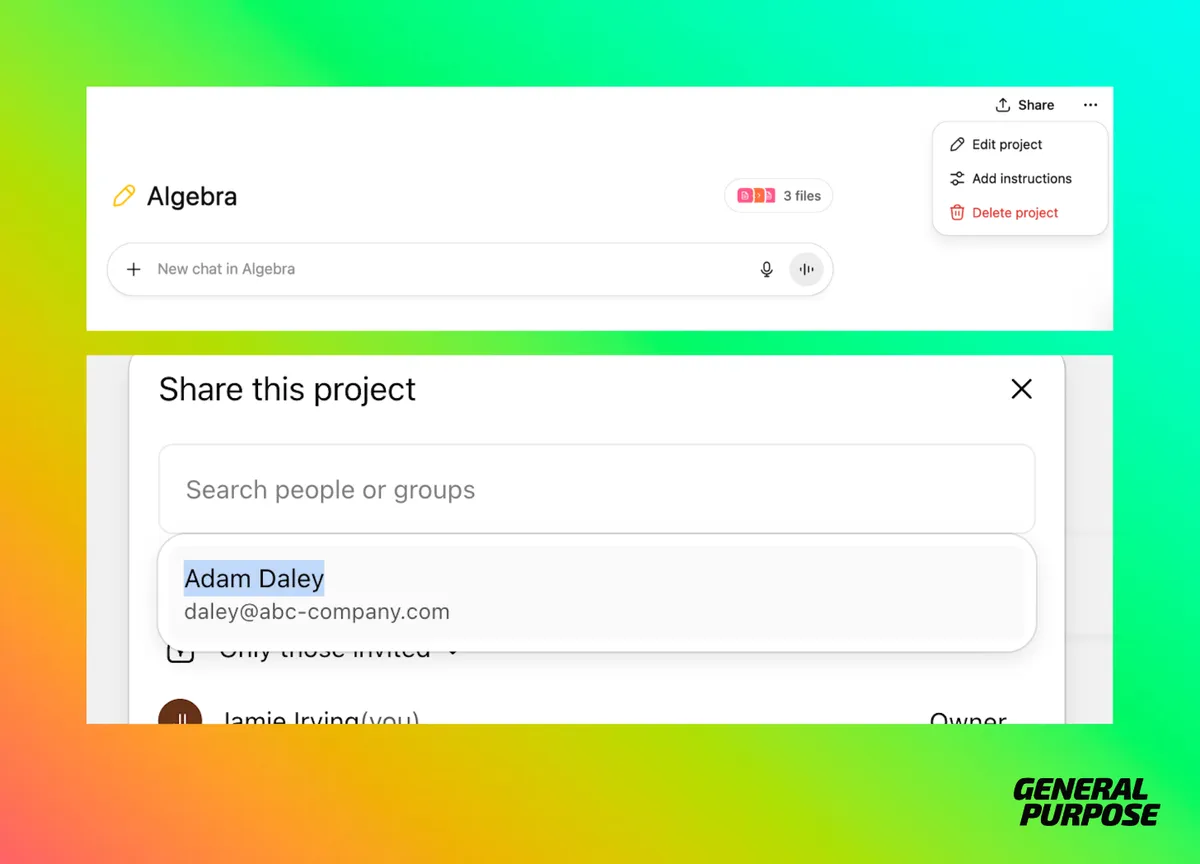
One of the biggest weaknesses in day-to-day ChatGPT use has been collaboration.
It has been easy for one person to do useful work with a chat. It has been much harder to turn that work into something a team can actually reuse without losing context along the way.
OpenAI's update allowing users to share entire ChatGPT Projects is a meaningful fix.
Shared Projects are much more useful than shared chats
Previously, if you wanted to reuse work, you typically shared a single conversation. That meant passing around outputs without the full setup that made them useful in the first place.
Shared Projects are different because they can hold:
- files
- instructions
- contextual notes
- previous conversations
- reusable templates
That makes them much better suited to team workflows.
Instead of saying, "Here is the output I got," you can now say, "Here is the environment we use for this kind of work."
That distinction matters.
Where shared Projects are most useful
The clearest use cases are recurring collaborative tasks such as:
- quarterly reporting
- compliance reviews
- shared writing environments
- internal research projects
- standardised client communication
- team playbooks for common work
For example, a team can create a Project containing:
- company tone of voice
- style guides
- approved prompts
- reference documents
- examples of strong outputs
Anyone joining the Project starts from the same base rather than rebuilding that context individually.
Thinking-time controls are useful, but secondary
At the same time, OpenAI introduced more explicit control over how long ChatGPT 5 should "think" before responding.
That has practical value:
Auto for everyday tasksFast for speed-sensitive workThinking for more complex analysis
But for most organisations, the more important update is still shared Projects.
Thinking-time controls help individuals tune answers. Shared Projects help teams standardise work.
Pulse points towards continuity
OpenAI also introduced Pulse, a format for structured recurring conversations with ChatGPT.
The interesting thing about Pulse is not scheduling on its own. It is continuity. It suggests a future where AI interactions become persistent routines rather than isolated requests.
That is a useful direction, but it is still early.
Connectors make the collaboration story stronger
This Projects update also fits neatly with the wider connector ecosystem.
When ChatGPT can access the tools your team already uses, the practical value of a shared Project increases. It becomes easier to ask questions against a live working context rather than a manually assembled one.
That is why shared Projects matter more than they might first appear. They are not just a collaboration feature. They are part of a shift from one-person chat sessions towards shared AI workspaces.
The broader implication
The organisations getting the most from AI are not simply handing employees access to a model and hoping for the best.
They are creating:
- shared ways of working
- repeatable patterns
- approved contexts
- stronger defaults
Shared Projects support exactly that.
For teams that want to move beyond ad hoc prompting, this is one of the more useful product changes OpenAI has shipped.