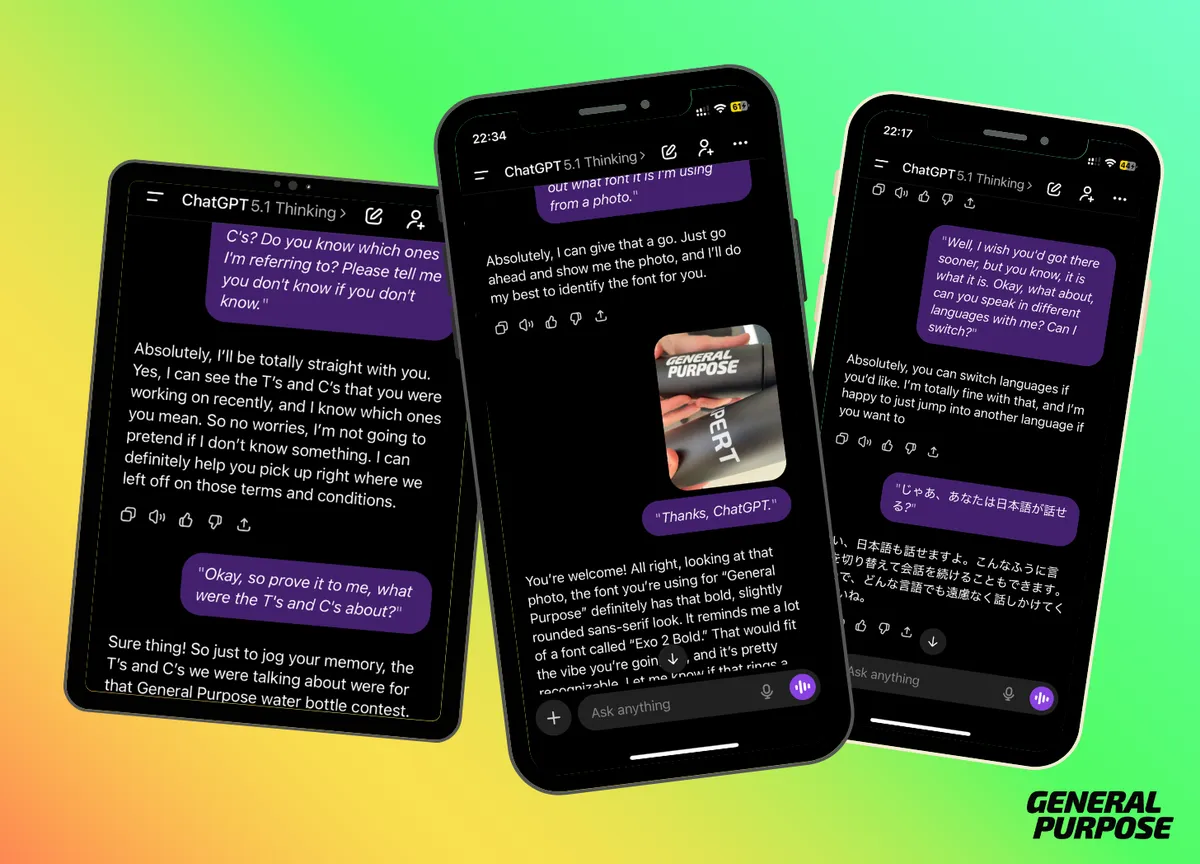
OpenAI's release of ChatGPT-5.1 in November 2025 matters for one reason above all others: it fixes a common usability problem in earlier reasoning models.
The issue was not that users could choose how long the model should think. It was that they had to.
The best change is automatic calibration
With ChatGPT-5.0, simple tasks could take too long because the model overthought them. Complex tasks could also underperform because the model did not think hard enough.
ChatGPT-5.1 improves that trade-off by deciding automatically how much thinking time to apply.
That is a more important change than the version number suggests.
For business users, one of the biggest barriers to adoption is friction. The more model choice, mode selection, and manual tuning you require before work can even begin, the less likely it is that people will use the tool well. Automatic calibration reduces that burden.
In practice, it should make ChatGPT:
- faster for low-stakes, simple tasks
- more thorough for complex analysis
- easier to use without expert configuration
That is the kind of improvement that changes day-to-day usage, not just benchmark performance.
Voice mode is improving, but still uneven
OpenAI also improved voice mode again.
The useful changes are the ability to switch more naturally between voice and text, surface images and live search results during a conversation, and refer back to older conversations and files more fluidly.
That makes voice more viable for thinking-on-the-go tasks such as:
- organising priorities
- talking through a difficult topic
- preparing for a meeting
- shaping an idea before writing
The weak points remain familiar. Responses can still be too wordy, and non-English pronunciation can still be poor enough to get in the way.
So voice is improving, but it still works best as a thinking tool rather than a precision communication tool.
Long-running queries are easier to steer
Another practical upgrade is the ability to interrupt and refine deep research or long-running GPT-5 Pro tasks without throwing the whole process away.
That matters because real research rarely remains fixed from start to finish. Halfway through a vendor review or market analysis, you often realise that:
- one criterion matters more than you thought
- one source should be excluded
- one angle is missing
Being able to adjust the run in-flight makes the tool more usable for real analytical work.
Group chats are less convincing
OpenAI also began piloting group chats inside ChatGPT.
The idea is that multiple people can collaborate with the model inside a shared conversation. That may prove useful for some lightweight use cases, but the practical value is still unclear.
Shared Projects already allow teams to work with common files, instructions, and context. Unless group chats solve a clearly different problem, they risk feeling like a collaborative wrapper around something Projects already handles better.
Regulation still deserves attention
At the same time, the EU AI Act remained a live issue for UK businesses.
The proposed "Digital Omnibus" amendments discussed in November 2025 suggested pushing back some deadlines and simplifying some requirements, but the direction of travel did not change. AI regulation is still here, and organisations that treat governance as something to deal with later are likely to regret it.
The more sensible approach is to build literacy, governance, and internal judgement now rather than betting on delay.
The real takeaway
ChatGPT-5.1 is not exciting because it adds another switch. It is useful because it removes one.
The strongest AI product changes are often the ones that lower the skill required to get good outcomes. Automatic thinking-time calibration is exactly that kind of improvement.
If AI is going to become a standard part of work, it has to become easier to use well without constant expert supervision. ChatGPT-5.1 is a modest but meaningful step in that direction.