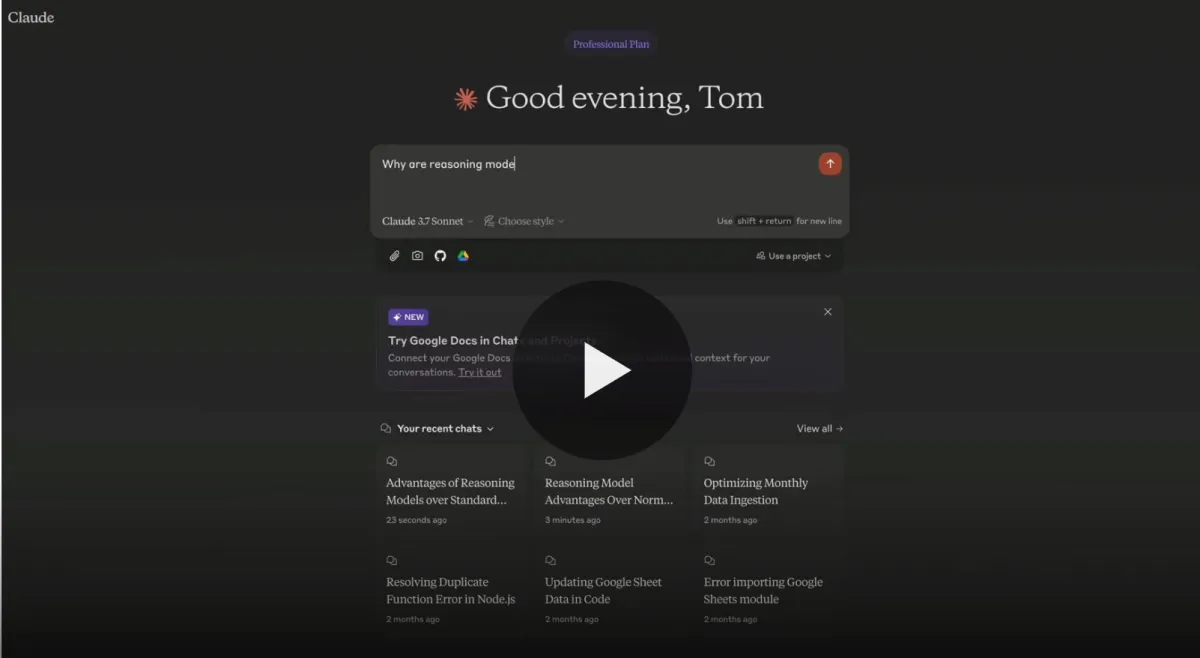
The software engineer’s favourite assistant - Claude from Anthropic, has had an upgrade with it’s newest model 3.7 Sonnet (who knows what happened to 3.6 as the previous version was 3.5 Sonnet?!).
While a less rounded package than ChatGPT, Claude is excellent at writing code and therefore is highly popular with developers. This programming prowess is reflected in Claude’s ability to write and run programmes within it’s native environment making it much easier for non-programmers to create interactive visualisations of data etc.
Rather than tell you about it though, I thought it would be more interesting to show you what Claude can do by giving it a simple prompt to produce a visualisation of how a large language model works which you can see below.
What you can see in this video is that I’ve enabled ‘Extended thinking’ mode which tells Claude to spend some time writing messages to itself about how to best approach my request before completing it. For those of you who have come on one of our classes you may recognise this as the “Plan + Solve” prompting technique. Yes, AI is learning to prompt engineer itself into producing better answers!
One of the things I like this new feature for is that Claude shows us those internal thoughts it had so we can get a sense of whether it truly understood the request. When OpenAI first pioneered this approach back in the autumn last year (feels like a lifetime ago) with the o1 model they refused to show these internal ‘chains of thought’ claiming that their competitors would use them to train their own models.
Thankfully Deepseek found a way to replicate OpenAI’s work and kindly released it open source so anyone could see how the model came to its conclusions. Once the cat was out of the bag there wasn’t much incentive for the AI labs to keep this internal thinking secret anymore and now Claude has followed Deepseek’s lead and lets us see what’s going on under the hood. OpenAI, meanwhile, have also come around to sharing these ‘thinking tokens’ and have said they’ll make them visible soon.
It’s one of the fascinating things about the intense competition between all the AI labs - whenever one thinks they’ve invented something special all the others try to replicate it straight away so that no-one gets too far ahead. This is either a very good thing if you believe in innovation and no one company becoming too powerful or a terrifying prospect if you fear we’re racing headlong over a cliff.
I, myself, am on the fence. AI has the potential to make the world a much better place than it currently is but the risks of wiping out millions of jobs and possibly worse are very real. As with all technology it comes down to how people use it and so the question we really need to ask is not whether we trust AI, but do we trust human nature?